
California Bike Lane Laws
California has some of the most detailed bicycle laws in the country, but knowing those laws is only half the equation. What most cyclists do not realize is that when a driver violates a specific traffic statute and causes a crash, that violation becomes direct evidence of negligence in a bicycle accident claim. Understanding your rights on the road makes you safer and puts you in a much stronger position if you are ever hit.
Cyclists Have the Same Rights as Drivers
Under California Vehicle Code Section 21200, cyclists have all the same rights and responsibilities as motor vehicle operators. You are entitled to use California’s public roads; drivers must treat you as they would any other vehicle, and you are required to follow the same traffic signals, stop signs, and lane markings as cars.
A 2024 Traffic Safety Survey found that nearly 40% of drivers incorrectly believe cyclists cannot use roads without bike lanes. That misunderstanding contributes directly to dangerous driving behavior and is one reason bicycle accidents remain so common in California despite the state’s strong legal protections for cyclists.
Where Cyclists Are Permitted to Ride
One of the most misunderstood areas of California bicycle law concerns where cyclists may ride on the road. CVC Section 21202 requires cyclists to ride as close to the right-hand curb or edge of the road as practicable, but only when it is safe to do so. The statute includes several explicit exceptions. Cyclists may move away from the right edge or take the full lane when passing another vehicle, preparing for a left turn, avoiding road hazards such as potholes or parked car doors, or when the lane is too narrow to safely share side by side with a motor vehicle.
This right-to-take-the-lane provision matters in litigation. Insurance adjusters frequently argue that a cyclist was at fault for riding in the travel lane rather than the shoulder or gutter. CVC Section 21202’s exceptions directly defeat that argument when the cyclist moved left for a legitimate reason.
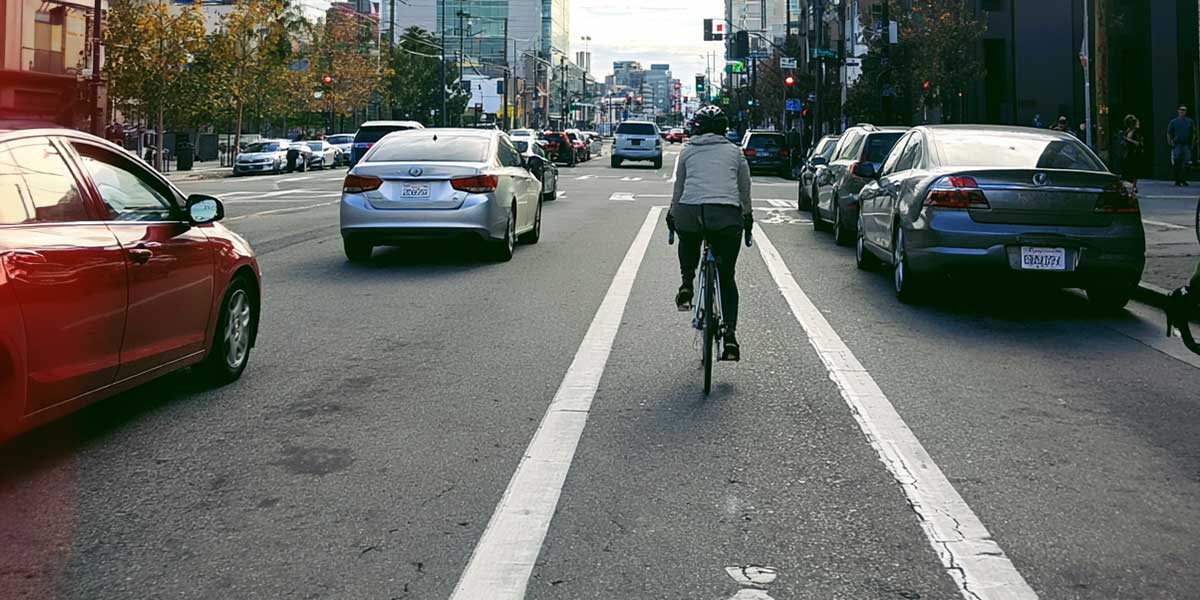
On roads with a designated bike lane, cyclists traveling slower than traffic are generally required to use it, with exceptions for left turns, passing, or avoiding hazards within the lane.
What Drivers Must Do Around Cyclists
The most significant recent change to California bicycle law concerns how drivers must pass cyclists. Under AB 1909, which took effect in 2024, a driver overtaking a cyclist traveling in the same direction must move to an adjacent lane before passing if one is available; the same standard applies when passing another motor vehicle. The prior three-foot minimum still applies as a fallback when a lane change cannot be made safely, requiring the driver to slow and wait before passing.
A driver who struck or sideswiped a cyclist while passing and who failed to change lanes when one was available has violated a specific statutory duty, making fault considerably easier to establish.
Drivers are also prohibited from entering a designated bike lane under CVC Section 21209, except when parking where permitted, entering or leaving the roadway, or preparing for a right turn within 200 feet of an intersection. Dooring a cyclist by opening a car door into the bike lane is a separate violation under CVC Section 22517.
Other Key Laws Cyclists Should Know
Under CVC Section 21456.2, which took effect in January 2023, cyclists may legally proceed through a signalized intersection when the pedestrian “Walk” signal appears, even if this differs from the green light controlling motor vehicles. This gives cyclists a head start through the intersection before vehicles begin moving, reducing the risk of right-hook and left-cross collisions.
CVC Section 21650.1 requires cyclists to ride in the same direction as adjacent traffic. Riding against traffic is a Vehicle Code violation and will be used by insurers as a comparative fault argument to reduce your recovery.
At night, cyclists must have a white front light visible from 300 feet, a rear red reflector or red light visible from 500 feet, and reflectors on both pedals or the cyclist’s ankles. California law requires riders under 18 to wear an approved helmet.
How Traffic Law Violations Affect Your Claim
When a driver breaks a specific statute and injures a cyclist, that violation is treated as negligence per se in California. This means you do not have to prove the driver failed to act reasonably. The violation itself establishes the breach of duty, and your case shifts to proving causation and damages.
If the driver who hit you failed to change lanes before passing, drove in the bike lane, doored you, or failed to yield at an intersection, each of those violations is a concrete legal hook that supports your claim. Without an attorney who knows how to identify and use those violations, that evidence can go unrecognized.
Comparative fault can also work against you. California follows a pure comparative fault system, meaning your damages are reduced by your percentage of responsibility. If a driver argues you were riding outside the bike lane when you had no legal obligation to be in it, and you cannot point to the specific CVC exception that applied, you risk having your recovery reduced unnecessarily.
Why You Need a Bicycle Accident Lawyer
Insurance companies handle bicycle accident claims every day. They know the Vehicle Code, they know which arguments reduce payouts, and they move quickly. Without legal representation, cyclists frequently settle for far less than their cases are worth, or see their claims denied on fault grounds that a knowledgeable attorney could have countered.
An experienced bicycle accident lawyer identifies which traffic laws the driver violated, gathers evidence to document those violations, works with accident reconstruction experts when needed, and negotiates with insurers who know they are dealing with someone prepared to go to trial.
Sacramento is one of the most dangerous cities in California for cyclists. The bicycle accident attorneys at Cutter Law P.C. have handled cases across Northern California, including cases involving government liability for dangerous road conditions and drivers who violated the Vehicle Code. Our Sacramento bicycle accident lawyers have a track record that includes Attorney Celine Cutter securing a $1.895 million verdict for a cyclist injured by a pothole in Sonoma County. Attorney John Roussas is currently litigating an active case involving dangerous roadway conditions near UC Davis set for trial in March 2027.
If you were injured while riding a bicycle, contact Cutter Law for a free consultation at 888-285-3333. We handle bicycle accident cases on contingency, meaning no fee unless we recover compensation for you.

Brooks Cutter is the founder of Cutter Law P.C., a personal injury and class action firm with offices in Sacramento, Oakland, and Santa Rosa, California. A Stanford Law School graduate and former law clerk to Chief Judge James R. Browning of the Ninth Circuit, Brooks has spent decades fighting for seriously injured clients against corporations and insurers. He is nationally recognized in complex class action and mass tort litigation, has secured verdicts and settlements worth hundreds of millions of dollars, and has been named a Northern California Super Lawyer every year since 2005. He is fluent in Spanish and a devoted father of three.