
Breach of Contract vs. Business Fraud — What’s the Difference?
- A breach of contract occurs when one party fails to fulfill their contractual obligations under a verbal, written, or implied agreement.
- Business fraud occurs when someone intentionally misrepresents or deceives others for the purpose of financial gain.
- Some cases of breach of contract can also be cases of business fraud, depending on when the alleged fraud occurred, whether the misrepresentation was separate from contract obligations, and whether there was intentional deception.
In a business contract, when one party fails to meet their obligations, two of the most common legal claims that may arise are breach of contract and fraud. While they may seem similar, these claims have distinct legal foundations, consequences, and remedies. At Cutter Law, our business litigation attorneys handle breach of contract and business fraud cases across California and can help determine what causes of action you may be able to pursue in court.
- What Is a Breach of Contract?
- What Is Business Fraud?
- Key Differences: Breach of Contract vs. Business Fraud
- Can a Case Be Both Breach of Contract and Fraud?
- Evidence Needed for Each Type of Claim
- When to Contact a California Business Litigation Attorney
- Ready to Discuss Your Contract or Fraud Dispute? Cutter Law Is Here to Help
What Is a Breach of Contract?
A breach of contract occurs when one party to an agreement fails to fulfill its obligations under the contract. A contract does not necessarily have to be a written agreement; it can also be an oral agreement or implied from the situation. In breach of contract cases, one party to the contract argues that the other party has broken their agreement and that the breach harmed them in some way. For example, if a client refuses to pay a company for the services they provided or a contractor refuses to finish a project, they may be liable for breach of contract.
For a contract to be legally binding and enforceable, allowing someone to sue, there must be a mutual agreement, an offer and acceptance, consideration, capacity by all parties, and a legal purpose. Certain types of contracts, such as real estate agreements, must be in writing to be considered enforceable.
To prove that a breach of contract occurred, you will need to establish four factors: the existence of a valid contract, your performance or excuse for non-performance, the other party’s breach of contractual obligations, and the damages caused by the breach.
What Is Business Fraud?
Unlike most breach of contract claims, business fraud involves intentional misrepresentation, concealment, or deceit for the purpose of financial gain. For example, a business may falsify financial records to attract investors — that is considered fraud. The intent to deceive is the core differentiator between fraud and breach of contract.
In California, you may be entitled to damages if you can prove the following elements of fraud: misrepresentation of the facts, knowledge that the information was false, intention to deceive, reasonable reliance on the false information, and damages. If there was no intention to deceive, you may still be entitled to compensatory damages for negligent misrepresentation.
Key Differences: Breach of Contract vs. Business Fraud
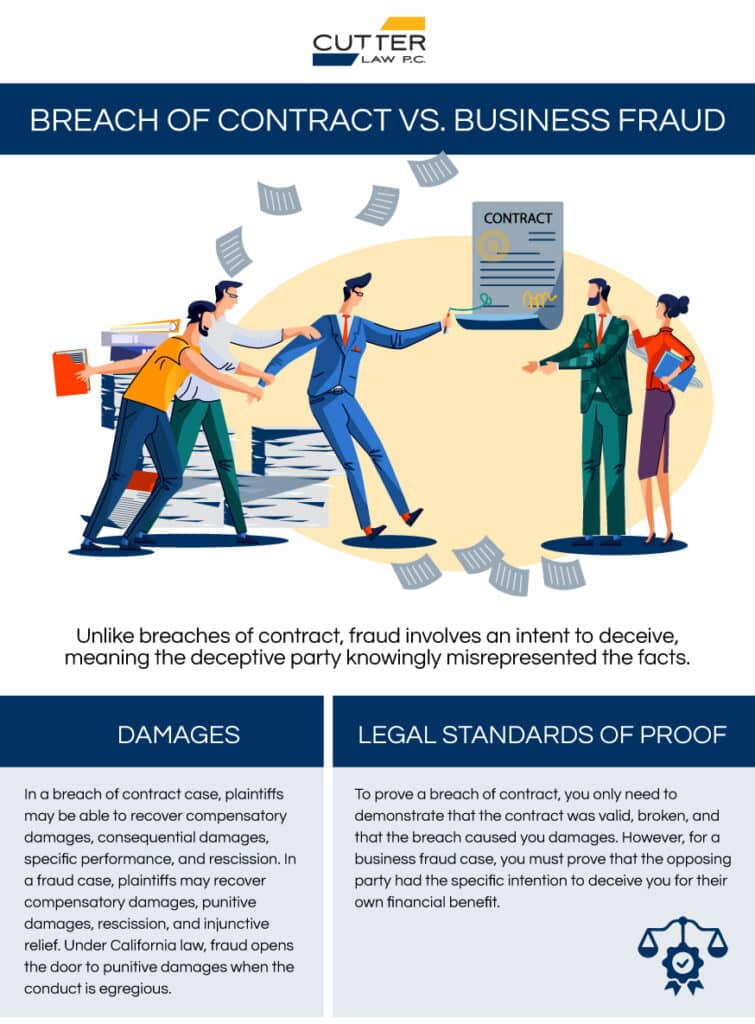
Intent: Unlike breaches of contract, fraud involves an intent to deceive, meaning the deceptive party knowingly misrepresented the facts.
Damages: In a breach of contract case, plaintiffs may be able to recover compensatory damages, consequential damages, specific performance, and rescission. In a fraud case, plaintiffs may recover compensatory damages, punitive damages, rescission, and injunctive relief. Under California law, fraud opens the door to punitive damages when the conduct is egregious.
Legal standards of proof: To prove a breach of contract, you only need to demonstrate that the contract was valid, broken, and that the breach caused you damages. However, for a business fraud case, you must prove that the opposing party had the specific intention to deceive you for their own financial benefit.
Can a Case Be Both Breach of Contract and Fraud?
It is possible for a breach of contract claim and a fraud claim to arise from the same incident. This can occur when a party fails to fulfill its contractual obligations and intentionally deceives the other party. For example, if a company enters a contract with a supplier who guarantees they have enough inventory to fulfill an order, but the supplier knowingly lacks the inventory, the buyer may have grounds for both breach of contract and fraud claims when the supplier fails to deliver.
Many breach of contract and fraud cases overlap when one party intentionally misrepresents something to get the other party to enter the agreement. When determining which causes of action apply, courts consider the following elements:
- Whether the fraud occurred before or during contract formation (fraudulent inducement).
- Whether the misrepresentation was separate from the contractual obligations.
- Whether there was intentional deception rather than merely a failure to perform.
Evidence Needed for Each Type of Claim
The typical forms of evidence you may use to prove a breach of contract or fraud claim include contracts, emails, text messages, financial documents, proposals, invoices, timelines, and witness statements. Fraud requires stronger evidence demonstrating intent or reckless disregard for the truth, so it’s important to preserve all documentation and communication surrounding the contract early, just in case.
When to Contact a California Business Litigation Attorney
Some breach of contract cases can be resolved quickly and easily, but when fraud is involved, the case may be serious enough to require legal assistance. When a breach of contract or business fraud incident threatens your business or professional reputation, you need a legal team with a thorough understanding of California’s business laws. At Cutter Law, our attorneys have over a century of combined experience in resolving complex contract disputes successfully.
As California natives, Cutter Law’s attorneys leverage our in-depth knowledge of the state’s industries and legal landscape to develop effective strategies to help you get the best results possible. We work tirelessly to protect our clients from deceptive business practices like fraud. With a free consultation, we can help you determine whether your claim is a breach of contract, business fraud, or both. We will work to determine the best course of action moving forward.
Ready to Discuss Your Contract or Fraud Dispute? Cutter Law Is Here to Help
If you or your business has experienced a breach of contract or an incident of business fraud, it’s essential to act quickly to preserve evidence and avoid further losses. Cutter Law can assist you in gathering all necessary evidence, evaluating your case, and determining which cause of action to pursue in court.
As a family-owned law firm, we strive to provide a family-like experience to our clients by fostering close, attorney-client relationships built on strong communication. Contact us today for a free case evaluation by calling 888-285-3333 or filling out our online contact form.

You can sue for bait-and-switch advertising in California when a company misleads consumers into purchasing a more expensive product than advertised, violating consumer protection laws.

To prove business fraud in California, gather evidence such as contracts, emails, financial records, and witness testimonies that show false statements and your reliance on them.

In California, deceptive business practices, such as false advertising and hidden fees, are illegal, and victims can seek compensation under various consumer protection laws.